


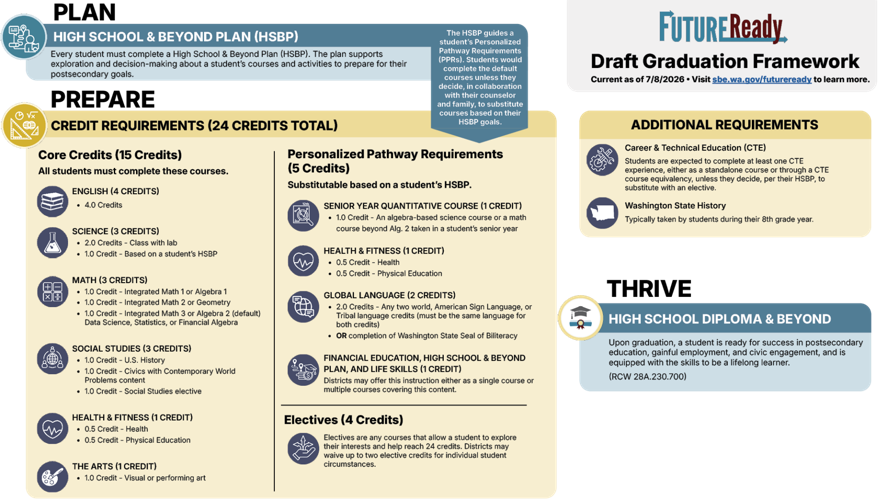

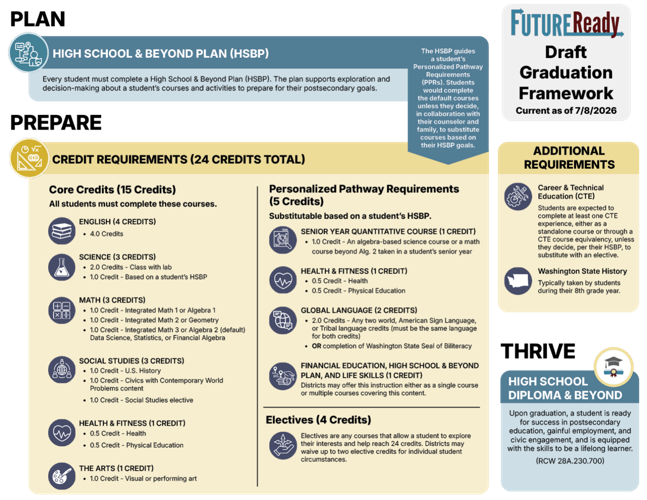
OLYMPIA, Wash. — The Washington State Board of Education has released a draft proposal for the first comprehensive update to Washington's high school graduation requirements in more than a decade. The proposal is part of the Board's FutureReady initiative to modernize graduation requirements and better prepare students for college, careers, and life. During its September meeting, the Board is expected to vote on a final proposal that will be submitted for consideration during the 2027 Legislative Session.
FutureReady was intentionally designed to move beyond traditional policy development by creating a shared process where ideas, experiences, and solutions were developed alongside students, educators, and community members. The resulting proposal comes after almost two years of collaboration with hundreds of students, families, educators, employers, higher education, and community organizations from across the state. The proposal was also shaped by formal and informal Tribal consultation with federally recognized Tribes in Washington and those Tribes with unceded interest in the state.
People are also reading…
"Our students, and communities whose voices are not often at the education policy table, have clearly communicated the revisions they want to see — and we are listening," said Mary Fertakis, Chair of the Washington State Board of Education. "Students deserve a graduation framework that prepares them for the opportunities and challenges they'll face after high school. This proposal preserves strong academic expectations while giving students more flexibility to connect their learning to their postsecondary goals.”
Over the coming months, the Board will continue refining the proposal with the FutureReady Task Force, implementation partners, and communities across Washington. Some recommendations in the proposal will require legislative action. Other recommendations will be implemented through the State Board’s rulemaking process.
The Board is expected to adopt a resolution outlining the Board’s proposal at its August 12-13 meeting. On September 10, the Board is expected to vote on approval of a draft bill that will be submitted for consideration during the 2027 legislative session. As this proposal moves through the legislative process, the Board remains committed to collaborating with legislators and other stakeholders to ensure that any changes to the proposal best serve Washington's students.
The Board is expected to release draft rules in fall 2026 for recommendations that can be implemented by the State Board’s rulemaking process. The Board will share more about the rulemaking timeline, including opportunities for public comment, as information is available.
The draft recommendations would strengthen postsecondary planning and preparation, expand opportunities for personalized learning, streamline existing graduation requirements, and better recognize student learning that occurs both inside and outside the classroom. It does all this without reducing strong academic expectations.
Key elements of the FutureReady proposal
The proposal includes recommendations that would:
Give students more flexibility to align their coursework with their goals after high school, while maintaining strong academic expectations, by expanding Personalized Pathway Requirements. The revised graduation framework would replace the current High School Graduation Pathways, which are primarily exam based, with a default set of courses that prepare students for a wide range of postsecondary goals. Individual students would be able to substitute these default courses with ones that better support their postsecondary plans, in consultation with educators and families.
Better support student postsecondary planning by creating a course that integrates financial education, life skills, and High School and Beyond instruction into the graduation framework with flexibility for districts to implement in a way that meets their student and community needs.
The Board reviewed Superintendent Reykdal's proposal for a Launch Course, which also would address financial education and life skills instruction. Based on our multi-year collaboration with the FutureReady Task Force, educators, communities, Tribes, and students, the Board had previously determined that each subject would require more instructional time and are recommending increasing civics to 1.0 credits and providing 1.0 credits for financial education, life skills, and High School and Beyond Plan instruction with the above-noted district flexibility. Learn more about OSPI's proposal here.
Strengthen civics education, as noted above, by combining Civics and Contemporary World History, Geography, and Problems into a single year-long course that gives students more time to explore history, geography, current issues, and civic participation.
Strengthen mathematics preparation by narrowing the third credit of math to include Algebra II or Integrated Math III as a default while giving students the option to take Data Science, Statistics, or Financial Algebra in alignment with their High School and Beyond Plan. In addition, the proposed framework recognizes the need for a Senior Year Quantitative Reasoning course to ensure all post-secondary options are available to students.
Give students more opportunities to receive instruction in health by rebalancing health and physical education credit requirements. Additional instruction in mental health is one of the most requested updates the Board has received from students. This change will provide room in the credit framework to meet this need.
Create more consistent statewide policies for flexible credit options, including competency-based credit and Career and Technical Education course equivalencies.
The earliest any new requirements proposed through FutureReady could take effect would be with students entering ninth grade in fall 2027 (the Class of 2031). Even then, some updated requirements may be phased in over a longer timeframe to allow for adequate support and effective rollout.
For more information on each of these proposal elements, and all other elements of the proposal, visit the Board’s FutureReady webpage.


