


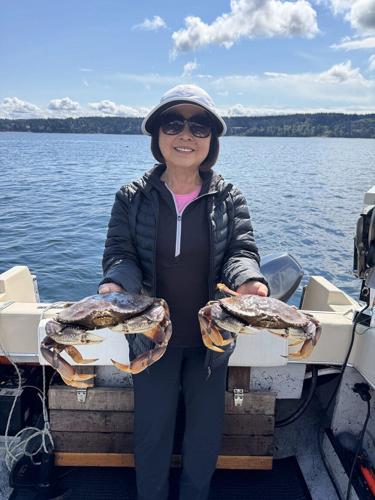
OLYMPIA – Recreational crab fishing will get underway in Marine Area 7 North (San Juan Islands) beginning Saturday, Aug. 15, Washington Department of Fish and Wildlife (WDFW) shellfish managers announced today.
In Marine Area 7 North (San Juan Islands), also referred to as the Gulf of Georgia, crabbing will be open Aug. 15 through Sept. 28 on Thursdays through Mondays only.
“We are pleased to announce the opening of Marine Area 7 North to recreational crabbing now that results from co-manager test fisheries show enough crab have reached our hardshell criteria,” said Aaron Dufault, WDFW’s Puget Sound Shellfish Division manager.
The Dungeness crab in this portion of Marine Area 7 tend to molt – shed their old shell and replace it with a new, larger shell – later than in other parts of Puget Sound.
People are also reading…
WDFW and tribal co-managers conduct test fisheries annually to ensure that legal-size Dungeness crab have reached the hardshell criteria for harvest in the fishing area. The start date will aid in achieving harvest sharing goals with treaty tribes.
Refer to WDFW’s recreational crab seasons and areas webpage for additional details including gear rules.
Other summer crab seasons
Other summer crab seasons open include:
- Marine Area 4 (Neah Bay east of the Bonilla-Tatoosh line), Marine Area 5 (Sekiu and Pillar Point), Marine Area 6 (East Juan de Fuca Strait, Port Angeles, Discovery Bay), Marine Area 8-1 (Deception Pass), Marine Area 8-2 (Port Susan/Everett), and Marine Area 9 (Admiralty Inlet) are open through Sept. 7 with crabbing allowed Thursdays through Mondays only.
- Marine Area 7 South (San Juan Islands/Bellingham) is open through Sept. 28 with crabbing allowed Thursdays through Mondays only.
- Marine Area 10 (Seattle-Bremerton Area) is open through Sept. 7 with crabbing allowed Sundays and Mondays only.
- Marine Area 11 (Tacoma-Vashon Island) is open through Aug. 17 with crabbing allowed Sundays and Mondays only.
- Marine Area 12 (Hood Canal) north of a line projected true east from Ayock Point is open through Sept. 7 with crabbing allowed Thursdays through Mondays only.
Closures to protect crab populations
The following areas are closed to protect low Dungeness crab populations:
- Marine Area 12 (Hood Canal) south of a line projected true east from Ayock Point and Marine Area 13 (South Puget Sound) are closed until further notice.
Catch sampling and regulations
WDFW has catch samplers (also known as creel checkers) at many boat launches and water access sites this summer to gather additional information from recreational crabbers. Catch samplers typically measure Dungeness crabs and obtain a total weight of the crabs retained to monitor the health of the population. The information these staff collect is important for crab fishery management. To read more refer to the catch sampling blog.
WDFW asks all crabbers and fishers to respect catch sampling staff and understand that in some locations boats may be checked for both Dungeness crab and for salmon or other finfish.
The daily limit throughout the Puget Sound Management Area, which includes all marine areas east of the Bonilla-Tatoosh line in Marine Area 4 (Neah Bay), is five Dungeness crab, males only, in hard-shell condition with a minimum carapace width of 6 1/4 inches. Fishers may also keep six red rock crab of either sex per day in open areas, provided the crab are in hard-shell condition and measure at least five inches carapace width.
Recreational crabbers may not set or pull shellfish gear from a vessel from one hour after official sunset to one hour before official sunrise. Each unattended trap or pot must have its own buoy line and a separate buoy that is permanently and legibly marked with the first name, last name, and permanent address of the licensed harvester. All traps must be removed from the water on days when the fishery is closed.
Make sure crab pots are properly weighted down to avoid them from moving and becoming lost, especially in deeper waters or areas with strong currents. Refer to WDFW’s crabbing webpage for tips for how to properly set crab traps.
Licensing and catch record requirements
Crab fishers age 16 and older must have a valid 2026-2027 recreational fishing combination or Shellfish/Seaweed license available on WDFW’s website, through the MyWDFW mobile app, or from license dealers and WDFW regional offices. All crabbers in the Puget Sound Management Area regardless of age must possess a Puget Sound Crab Endorsement and paper or electronic catch record card (CRC/eCRC). More information is available on WDFW’s Puget Sound Dungeness crab catch record card webpage.
Completed summer CRC/eCRCs, regardless of whether any crab are kept, must be submitted or reported online to WDFW by Oct. 1, 2026.
“It is crucial that every crabber record their Dungeness catch immediately on their CRC, whether it be the paper version or the electronic version,” said Velasquez. “Those choosing the electronic CRC option and who record catch with that system will automatically report harvest. Those choosing the paper option will need to remember to report their harvest by the deadline printed on the CRC. Accurate and timely catch information is essential if we are to provide this summer opportunity for family recreation into the future.”
Other fishing rules and whale protections
A rule adopted in 2025 prohibits setting crab/shrimp gear from a vessel near 19 designated Washington State Department of Transportation-managed ferry terminals in Puget Sound and the San Juan Islands (Marine Areas 7, 8-1, 8-2, 9, 10, and 11). To view the complete rule, refer to the WDFW fishing rules webpage.
Crabbers and other boaters are reminded to follow Washington rules to help protect endangered Southern Resident killer whales (SRKWs). Under state law recreational vessels in Washington waters must stay 1,000 yards away from Southern Resident killer whales (SRKW). Refer to the SRKW webpage for more information on the regulations. For details about steps boaters and fishers can take to keep the whales – and themselves – safe, refer to the Be Whale Wise website.
WDFW works to preserve, protect, and perpetuate fish, wildlife and ecosystems while providing sustainable fish and wildlife recreational and commercial opportunities.


